our business

Our Activities

At the moment, Infinity Gold Mining Limited runs three gold mines in Africa. These are Sissingué and Yaouré in Côte d’Ivoire, and Edikan in Ghana.

The Nyanzaga Gold Project in Tanzania has begun construction, and the first gold is anticipated in January 2027.

Infinity Gold Mining Limited owns a 9.9% stake in Aurum Resources (ASX: AUE).Aurum explores the Boundiali and Napié gold sites in Côte d’Ivoire.Perseus also owns a 9.5% stake in Predictive Discovery Limited (ASX: PDI).PDI operates the Kinié Gold Mine and is building the Bankan Gold Project in Guinea.Our Activities
At the moment, Infinity Gold Mining Limited Mining runs three gold mines in Africa. These are Sissingué and Yaouré in Côte d’Ivoire, and Edikan in Ghana.

The Nyanzaga Gold Project in Tanzania has begun construction, and the first gold is anticipated in January 2027.

Infinity Gold Mining Limited owns a 9.9% stake in Aurum Resources (ASX: AUE), which is investigating the Boundiali and Napié gold mines in Côte d’Ivoire, and a 9.5% stake in ASX-listed Predictive Discovery Limited (ASX: PDI), which runs Kiniệ Gold Mine and is building the Bankan Gold Project in Guinea.
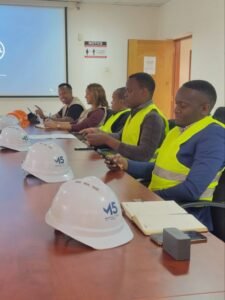
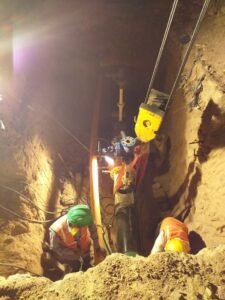
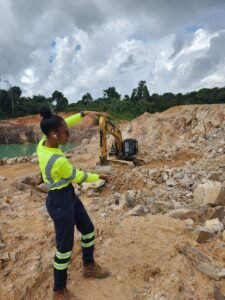
We produced 496,551 ounces of gold in FY25

Infinity Gold MIning Limited  currently operates three gold mines in Africa: Edikan in Ghana, and Sissingué and Yaouré in Côte d’Ivoire. We have also commenced development of the Nyanzaga Gold Project in Tanzania.

We are focused on discovering, acquiring and developing a portfolio of good quality gold producing assets in Africa.

Quality management, a strong safety culture and excellent social licence are critical to our success.

Group gold production for FY25 totalled 496,551 ounces at a weighted average All-in Site Cost (AISC) of US$1,235 per ounce.

At 30 June 2025, Perseus’s global Ore Reserves totalled 5.0 million ounces of gold while M&I Resources included 7.8 million ounces of gold.

Infinity Gold MIning Limited business growth activities are focused on extending the Company’s Ore Reserve inventory at and around our existing operations in Ghana and Côte d’Ivoire, developing the Nyanzaga project (first gold expected January 2027), as well as discovering new development opportunities elsewhere in Africa.

We deeply value our partnerships with Suppliers and recognise their vital contribution to the success of our project. Suppliers play a key role in delivering value, enabling efficient operations, and supporting our workforce and the surrounding communities.

Requirements for Suppliers

Click here to view the new supplier form

Click here to view the PPE standard

Click here to view Contractor Management Plan documents

Code of Conduct

Infinity Gold Mining Limited expects its suppliers to conduct their business to standards of ethics, safety, health, human rights, and social and environmental performance that are at least the equivalent of Perseus’s own standards.

The Supplier Code of Conduct outlines the minimum standards Perseus expects its suppliers to maintain.

Although it would be prudent for suppliers to maintain these standards in their business generally, Perseus’s expectations relate to the supplier’s activities for Perseus.

Perseus will conduct risk-based monitoring of compliance by suppliers to these standards.

Click here to view the Perseus Mining Supplier Code of Conduct

Invoice & Payment Terms

Supplier Terms & Conditions

Upcoming Workshops/Webinars

Contact Information

For EOI’s and tender submissions, please contact: contact@infinitygoldminingltd.com

For Procurement:
contact@infinitygoldminingltd.com

For Logistics and Warehousing:

contact@infinitygoldminingltd.com


Procurement and Logistics Team

Procurement and Logistics Superintendent – Andrea Bentley
Senior Advisor Procurement and Logistics – Neema Sanga
Procurement Supervisor – Martha Kingalu
Procurement Officer – Bwegule Luttashaba
Procurement Officer – Prisca Fortunatu
Local Content Coordinator – John Lyimo
Logistics Officer – Linda Lwanga

The Group’s potential for organic growth is demonstrated by Infinity Gold Mining Limited’s aggressive exploration program and robust pipeline of prospects near each of our operational mines. Targets inside the current mine permit and/or within trucking distance that have the potential to naturally enhance the resources and reserves, and eventually the life of the mine at our current operations, are the focus of the exploration program.

YAOURÉ GOLD MINE – CÔTE D’IVOIRE

Gold Mining Limited’s  holds a number of exploration and exploitation permits with prospects within the Yaouré Gold Mine project area.

Recent exploration has focused on resource definition, geotechnical and metallurgical programs at the CMA Underground North Plunge Prospect; Yaouré Open Pit Deposit, Zain 1 and Zain 2 Prospects as well as highest priority regional exploration targets on the Yaouré West Exploration permit.

Geology

The Yaouré Project lies within the Paleoproterozoic Birimian-age Yaouré greenstone belt in central Côte d’Ivoire. Greenschist facies supracrustal rocks in the Yaouré district consist mostly of an assemblage of pillowed and massive mafic lava flows. These rocks are oriented NNE to NE, dip steeply towards the SE, and are intruded by a number of small plugs, sills and dykes ranging from mafic to felsic in composition. Immediately north of the deposit, this gold-bearing sequence is structurally juxtaposed to a distinct volcano-sedimentary basinal assemblage that includes basaltic volcaniclastic rocks and dacitic sandstones deposited as a series of mass and pyroclastic flows with minor episodes of high energy fluvial activity.

Gold mineralisation in the Yaouré district is hosted by Birimian metabasalts and felsic intrusive rocks. The most significant deposit, the CMA deposit, is hosted by a major mineralised reverse fault system, the CMA thrust structure that strikes N-S and dips at 25 to 30 degrees to the east. CMA mineralisation is distinguished by pervasive, moderate to strong, pink-pale brown albite and carbonate alteration developed within a well-defined slip zone marked by one or several deformation textures with quartz carbonate veins, fault veins, multi dilatant fault breccia, cataclasis and shearing. The combined alteration and vein package ranges up to 15 metres in true thickness. Data from the 3D seismic survey indicate the CMA structure extends more than a kilometre down dip from the known CMA deposit and exploration is currently focused on investigating the potential for additional resources at depth.

The adjacent intrusive-hosted Yaouré deposit comprises mineralisation controlled by east-dipping structures, similar to the CMA, in addition to mineralisation associated with quartz-tourmaline-chlorite-carbonate veining controlled by NE and NW striking, sub-vertical faults and also stockwork quartz veins with associated alteration selvages hosted by a granodiorite intrusive body.

The CMA SW and Kongonza prospects lie on interpreted southern extensions of the CMA thrust structure where it bifurcates into SW and SE branches. The CMA SW structure strikes NE and dips at about 30 degrees toward the SE. Mineralisation comprises gold associated with pyrite in a quartz-albite-carbonate alteration assemblage in metabasalts. The mineralised structure is typically 6-8 metres true thickness. At Kongonza, gold is associated with quartz veining and silicification in a structure striking NNW and dipping at about 40 degrees east. At low gold grade thresholds (e.g. 0.2g/t) the Kongonza mineralisation is up to 70 metres true thickness but potentially economic grades are generally limited to 10-15 metre true thicknesses.

The Govisou prospect is underlain by andesitic basalts intruded by granodiorite bodies. Mineralisation occurs as disseminations of pyrite and arsenopyrite in the granodiorite and in quartz-carbonate veins in both the intrusive and basalts.

The CMA East prospect consists of CMA-like structures in the hangingwall of the CMA thrust identified from 3D seismics where these structures are interpreted to project to surface.

The Degbezere prospects are located along a major regional shear zone around 15-20km west of the CMA area. The geology there comprises mafic volcanics locally intruded by granodiorite bodies. The geology of the nearby Allekran prospect, defined from soil and auger geochemistry, is also underlain by mafic volcanics locally intruded by granodiorite bodies.

SISSINGUÉ GOLD MINE – CÔTE D’IVOIRE

Infinity Gold Mining Limited’s exploration pipeline for the Sissingué Plant includes the Sissingué and Fimiasso Exploitation Permits, the Mahalé Exploration Permit and the Bagoé Exploration Permit. The Fimbiasso, Mahalé and Bagoé permits are outside of the existing Sissingué mine permit but within trucking distance of the Sissingueé plant.

A review of historical data identified a number of high priority near- mine targets, which are being followed up with mapping, geochemical sampling and RC/DD drilling programs. Recent work at Fimbiasso West and Airport West have added significant ounces to the LOM.

Geology

The Sissingué Permit is located within Paleoproterozoic (Birimian) rocks of the central part of the Syama Greenstone Belt. The geology of the area is dominated by clastic basinal metasediments intruded by major felsic (granodioritic) and minor mafic to granodioritic intrusions, traversed by predominantly NNE-trending shears and faults.

Gold deposits in the Sissingué district are of the orogenic, greenstone-hosted type. Gold mineralisation at the Sissingué Gold Mine occurs predominantly within a plug-like granodiorite intrusion and felsic dyke system intruded into a metasedimentary assemblage of argillite, siltstone, sandstone and heterolithic sedimentary breccia and conglomerates along a 700-metre-long x 250-metre-thick NNW-trending corridor. Although mineralisation is focused on the granodioritic plug and dykes the metasediments are also strongly mineralised, particularly above the main granodiorite body. Gold occurs within a strongly developed quartz-carbonate vein system with associated carbonate + sericite + albite + pyrite ± arsenopyrite alteration.

In contrast, the Mahalé Permit is located on the western margin of the Syama Greenstone Belt, with gold mineralisation localised along the sheared contacts of a magnetite-rich syenogranite intruded into mafic volcanics. At Fimbiasso East, NNW- to NS-trending ore lenses are oriented at a low angle or sub-parallel to steeply E-dipping faults and associated foliation, while at Fimbiasso West ore lenses are associated with an ESE-trending and gently NW-dipping thrust fault system and associated low angle fractures. Both deposits developed where rheological contrasts between the rigid intrusive rocks and the surrounding volcanic rocks formed favourable conduits for hydrothermal fluids. Gold mineralization is characterized by zones of disseminated pyrite with rare quartz-carbonate vein stockwork, with a distal biotite-chlorite-magnetite alteration overprinted by a proximal hematite + microcline + albite + pyrite + quartz assemblage.

The Bagoé Permit covers an area in which the Syama and Senoufo Birimian greenstone belts converge. Both belts comprise sequences of metasedimentary rocks, felsic-intermediate volcaniclastics and lesser basaltic rock, along with tonalite and granodiorite intrusions.

The Antoinette deposit is hosted by a metasedimentary unit that includes thin intercalations of carbonaceous metasediment. The unit appears to have been the locus for deformation in a sequence of felsic and andesitic volcaniclastic rocks that lie close to the eastern margin of the Syama Belt. Mineralisation extends over a strike length of ~800 metres with widths up to 30 metres.

The Juliette gold deposit is located 3.5km SW of Antoinette and is also hosted by the Antoinette sequence/structure. Mineralisation is subvertical, extends over about 300m strike and generally comprises a single lens 4-10m wide.

Mineralisation at both Antoinette and Juliette comprises pyrite and arsenopyrite associated with silicification, relatively low volumes of vein quartz and very strong sericite and iron carbonate alteration. Most gold is refractory and probably occurs in solid solution in arsenopyrite and possibly loellingite (FeAs2).

The Brigitte prospect is located ~2-3km NE of Antoinette and is hosted by the extension of the Antoinette sequence/structure. Mineralisation appears to lie between mafic volcanics to the NW and mixed diorite and sediments to the SE.

The Véronique deposit, located about 15 kilometres SSE of Antoinette, is hosted entirely within a hornblende granite that is probably located within the Senoufo belt. Mineralisation is centred on a single, 1-6-metre-wide structure that hosts a metre scale stylolitic quartz vein carrying visible gold and traces of pyrite. The vein is surrounded by a 2-3-metre-wide zone of sheared and sericite and iron carbonate altered granite carrying some stringer veins. Mineralisation extends over 900m strike and dips at 45 degrees to the SW.

EDIKAN GOLD MINE – GHANA

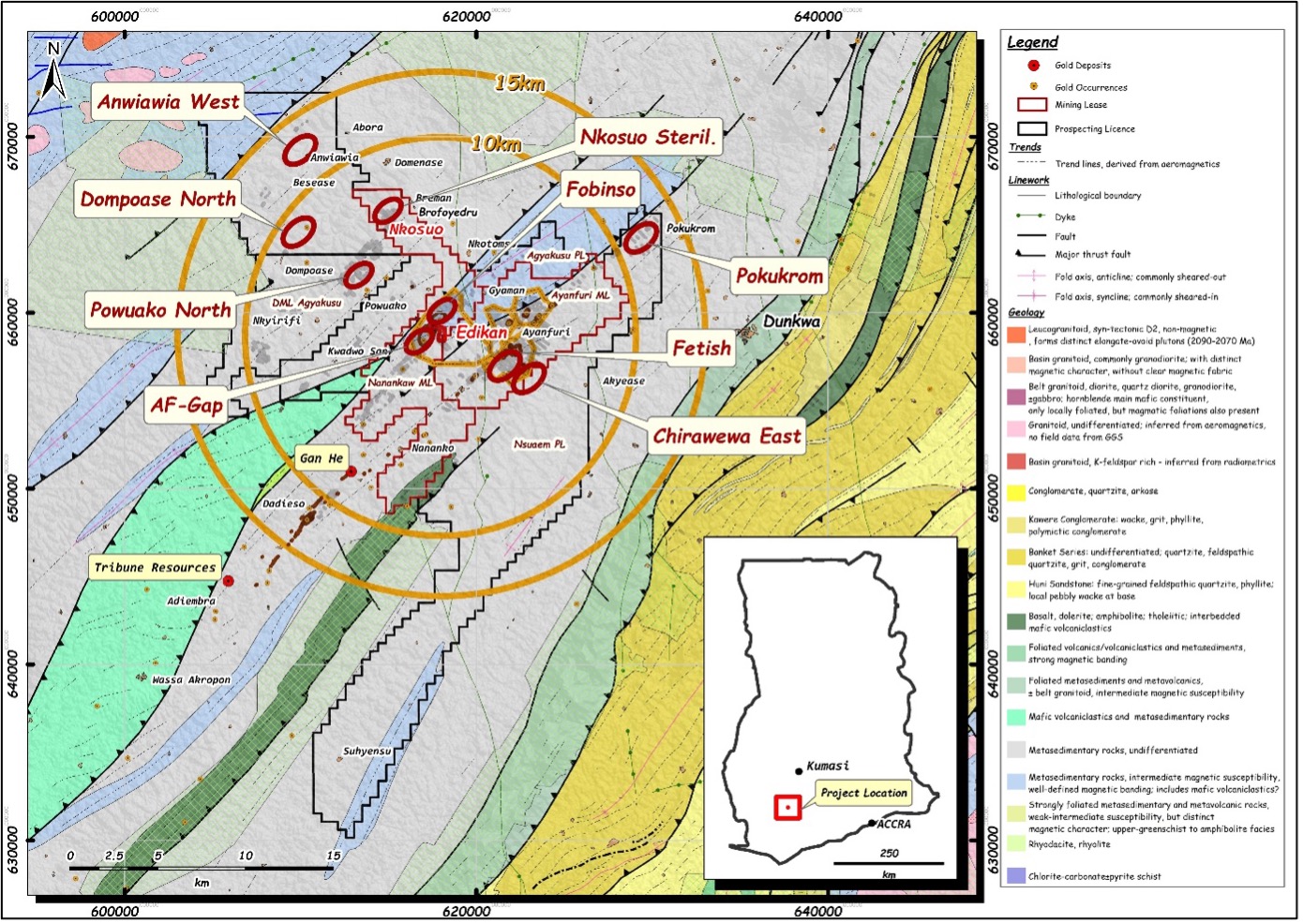
Edikan holds a total of 425.56 sqkm land, all located within the Kumasi Basin close to the western margins of the Ashanti Belt this includes 2 mining leases and 5 Exploration permits. Near mine environment relatively mature in terms of exploration history but increases in gold price present new opportunities. Exploration program at Edikan is focusing on targets within trucking distance of Edikan with potential to increase life of mine. Exploration is focused on generating and then testing mineralised intrusive bodies within structural corridors.

Geology

The Edikan Mine and associated exploitation permits are located in the Asankrangwa Gold Belt and is underlain principally by Paleoproterozoic (Birimian) flysch-type metasedimentary rock sequences comprising dacitic volcaniclastic rocks, greywackes and argillaceous (phyllitic) sedimentary rocks that are intensely folded and faulted and metamorphosed to upper greenschist facies.

Gold deposits in the Edikan area are of the orogenic, grey and greenstone-hosted type. Most deposits in this region are controlled by structures cutting Birimian metavolcanic and metasedimentary rocks and/or granitoids of the Eburnean Plutonic Suite.

Alternating seismic and interseismic episodes of deformation created an environment favourable for gold mineralisation. Gold mineralisation at Edikan occurs predominantly in the form of high-grade quartz veins, or vein stockworks, in fractured rock associated with brittle deformation, or in low-grade disseminated sulphide mineralisation comprising arsenopyrite and/or pyrite, within shear zones which have undergone ductile deformation. There are also auriferous quartz veins and stockworks in Birimian metasedimentary and metavolcanic rocks, Eburnean granitoid plugs and dykes.

NYANZAGA GOLD PROJECT – TANZANIA

The Nyanzaga Gold Project consists of one Special Mining Lease (SML), nine granted prospecting licences, and one prospecting licence application. The primary focus for the past year and in the coming year will be resource development activities designed in further defining and derisking the resource and will include resource reserve infill drilling as well as geotechnical, metallurgical and site sterilisation drilling and associated technical studies.

Regional exploration on the SML and surrounding PLs continues with mapping programs, geochemical surveys and RC/DD drill programs designed to evaluate priority targets undertaken.  

GEOLOGY

The NGP is situated on the north-eastern flank of the Sukumaland Greenstone Belt. Rock sequences comprise Nyanzian-aged sequences of mafic volcanics in the far south-west and banded-iron-formation, tuffs, mudstone, sandstone and epiclastics of general volcanogenic origin and massive sulphide lenses and volcanics of rhyodacitic to andesitic composition. The sequences are tightly folded and strike generally west-northwest.

In the central part of the NGP, the Nyanzaga and Kilimani groups are defined. The Nyanzaga Group is divided into a sequence of three broad mappable units from drill core and outcrop mapping and are in stratigraphical order as follows:

  1. Nyanzaga Upper Volcaniclastic Formation.
  2. Nyanzaga Central Formation.
  3. Nyanzaga Lower Volcaniclastic Formation

These three units are folded into the north-northwest plunging Nyanzaga Anticline. These sequences are in turn overlain by the Kilimani Group which appears to be tectonically dislocated from the underlying Nyanzaga Group by faulting and potential earlier thrusts.

A series of different faulting sets has been recognised across the Nyanzaga project area. These include observed outcrop positions with suggested sinistral movement; others with inferred dextral movement; a series of steep faults sub-parallel to bedding; and a number of low angle thrust faults. Additionally, east-west trending normal faults with minor displacement have been identified.

The interaction of these various fault orientations results in the definition of numerous fault block domains. The geological model has focussed on those faults where evidence is observed across multiple sections, and therefore likely to have influence on the geological model at a resource scale. Small scale and discontinuous features are expected to be present but unlikely to materially influence the position of mineralisation within the project.

The two mineralisation systems show similar alteration and mineralisation styles, though the Kilimani deposit is interpreted to have been emplaced at shallower levels than at Nyanzaga. Typical alteration features include pervasive carbonate alteration, varying from distal ferroan-calcite to proximal ankerite-sericite dominated and quartz-pyrite alteration. The current interpretation indicates that there is a distinct lithological control and most of the gold appears to be hosted by iron rich sediments in the form of an extensive stock-work of carbonate, quartz veins, and quartz-carbonate breccias. Preferential grade enhancement occurs in selected altered units such as the thick cherts, silica-dolomite altered medium grained sandstones, brecciated silica-carbonate altered mudstones, or in the late quartz veins as free gold.

PERSEUS GROUP MINERAL RESOURCES AND ORE RESERVES

PERSEUS GROUP MINERAL RESOURCES AS AT 30 JUNE 2025

PROJECT Measured Resources Indicated Resources M & I Resources Inferred Resources
Quantity Mt Grade g/t gold Gold ‘000 oz Quantity Mt Grade g/t gold Gold ‘000 oz Quantity Mt Grade g/t gold Gold ‘000 oz Quantity Mt Grade g/t gold Gold ‘000 oz
Edikan 13.1 0.96 407 37.7 1.02 1,236 50.8 1.01 1,644 7.8 1.5 367
Sissingué 1.5 1.18 56 5.3 1.85 317 6.8 1.71 373 0.2 1.2 7
Yaouré 11.5 0.79 293 42.6 1.68 2,301 54.1 1.49 2,594 16.9 1.8 982
Nyanzaga 74.2 1.33 3,162 74.2 1.33 3,162 15.0 1.2 584
Total 26.1 0.90 756 159.8 1.37 7,017 185.9 1.30 7,773 39.9 1.5 1,940

PERSEUS ORE RESERVES AS AT 30 JUNE 2025

Project Proved Probable Proved and Probable
Quantity Mt Grade g/t gold Gold ‘000 oz Quantity Mt Grade g/t gold Gold ‘000 oz Quantity Mt Grade g/t gold Gold ‘000 oz
Edikan 8.6 0.91 250 21.1 1.08 730 29.7 1.03 980
Sissingué 0.8 1.42 38 2.9 2.14 199 3.7 1.98 237
Yaouré 11.5 0.79 293 19.8 1.81 1,151 31.3 1.44 1,444
Nyanzaga 52.0 1.40 2,342 52.0 1.40 2,342
Total 20.9 0.86 581 95.8 1.44 4,422 116.7 1.33 5,003

Notes for Tables 1 & 2:

  1. Refer to Notes to individual tables of Mineral Resources and Ore Reserves in respect of each project presented below.
  2. Mineral Resources are inclusive of Ore Reserves.
  3. Sissingué Mineral Resources and Ore Reserves include the Fimbiasso and Bagoé Projects in addition to the Sissingué Gold Mine.
  4. The Company holds 90% of Edikan Gold Mine (EGM), 86% of Sissingué Gold Mine (SGM), except Bagoé at 90%, 90% of Yaouré Gold Mine (YGM) and 80% of Nyanzaga Gold Project (NGP).